
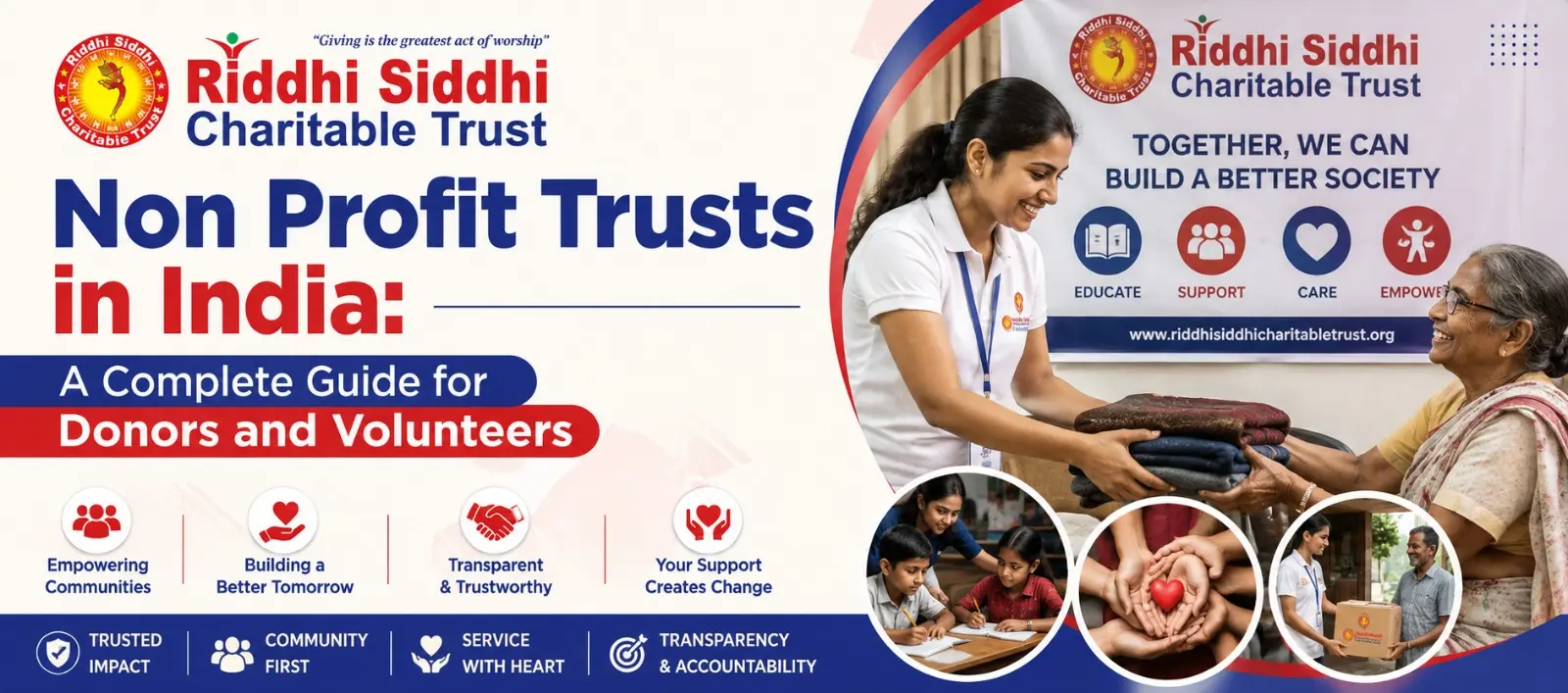
Non Profit Trusts in India: A Complete Guide for Donors and Volunteers
-
 Admin: rsct
- Aug. 22, 2026
Non profit trusts play an important role in addressing social challenges that government systems and commercial organisations cannot always solve alone. From education and healthcare to food distribution, elderly care, women’s empowerment and disaster relief, charitable organisations provide structured support to communities that need it most. For donors, however, choosing the right organisation requires more than simply finding a group that accepts donations. Understanding how charitable trusts operate, what their legal and financial responsibilities are, and how to evaluate their credibility can help ensure that a contribution creates meaningful impact.
What Is a Non-Profit Trust?
A non-profit trust is an organisation established to pursue charitable or social objectives rather than distribute profits to owners or shareholders. In India, charitable trusts may work in areas such as education, healthcare, poverty alleviation, child welfare, senior care, women’s empowerment, environmental protection and emergency relief.
The legal and tax framework applicable to a charitable organisation depends on its structure, registrations, activities and sources of funding. Donors should therefore distinguish between a trust’s general charitable status and specific registrations or approvals that may apply to tax benefits, grants, CSR projects or foreign contributions.
For example, the Income Tax Department explains that eligible institutions seeking benefits under Section 80G must satisfy specified conditions, including maintaining regular accounts of receipts and expenditure.
How Do Charitable Trusts Create Social Impact?
The work of a charitable trust usually involves identifying a community need, designing an intervention, mobilizing resources, and delivering support. The impact can be immediate or long-term.
Common activities include:
- Providing nutritious meals and ration kits to vulnerable families
- Supporting children with school fees, books, uniforms and educational materials
- Offering medical assistance to people who cannot afford treatment
- Supporting elderly people with shelter, food and basic care
- Conducting women’s empowerment and livelihood programmes
- Providing emergency assistance during floods, disasters or other crises
- Organising community awareness and healthcare camps
- Creating opportunities for volunteers to participate in social initiatives
A strong organisation generally combines immediate relief with initiatives designed to improve long-term independence. For example, food distribution may address an urgent need, while education and vocational support can help families become more self-sufficient.
What Should You Check Before Donating to Non Profit Trusts?
Choosing among non profit trusts requires basic due diligence. A donor should look beyond emotional appeals and examine whether an organisation clearly explains its mission, programmes, governance and use of funds.
1. Verify the organisation’s identity
Start by checking the organisation’s official website, legal name, registration details and contact information. The organisation should be able to clearly explain who manages it and what charitable objectives it follows.
Government-backed systems can also help donors understand the formal ecosystem. NITI Aayog states that its Voluntary Action Cell maintains the NPO Darpan portal, through which non-profit organisations can obtain a Unique Identity number; Darpan ID is required for certain government grants and is also relevant to FCRA and 80G processes.
Check here: NITI Aayog – Voluntary Action Cell
2. Understand tax-related claims
A common reason people research non profit trusts is to understand whether their donations can qualify for tax benefits. Section 80G provides deductions for donations to specified funds and institutions, subject to applicable conditions and limits. The Income Tax Department currently notes that cash donations above ₹2,000 are not eligible for deduction under Section 80G.
Importantly, donors should never assume that every donation to every charitable organisation automatically qualifies for a deduction. The organisation’s eligibility and the nature and method of the donation matter.
Income Tax Department – Section 80G
3. Look for financial transparency
Transparency is one of the strongest indicators of responsible charitable management. Look for clear information about programmes, expenditure, donation utilisation and organisational activities.
The Income Tax Department’s Section 80G framework itself refers to maintaining regular accounts of receipts and expenditure for qualifying institutions.
A donor can also ask practical questions:
- What programme will my donation support?
- Is the contribution unrestricted or campaign-specific?
- Can the organisation provide a donation receipt?
- Does it publish programme updates?
- Are there clear contact details?
- Does the organisation explain its impact?
4. Check CSR eligibility when donating through a company
Businesses considering partnerships with charitable organisations should conduct additional due diligence. Corporate Social Responsibility regulations contain specific requirements for entities undertaking CSR activities. MCA’s CSR rules include registered public trusts and societies with relevant tax registrations among the recognised entity categories for CSR implementation.
Check here: Ministry of Corporate Affairs – CSR Rules
This means companies should verify the documentation and eligibility of a prospective implementation partner before committing CSR funds.
5. Understand foreign-donation requirements
Foreign contributions are governed by the Foreign Contribution (Regulation) Act, 2010. Organisations receiving foreign contributions must comply with the applicable FCRA requirements rather than treating overseas donations in the same way as domestic contributions. The Ministry of Home Affairs maintains the official FCRA portal and publishes information about registered associations, rules, required documents and compliance.
Check here: Ministry of Home Affairs – FCRA Online Services
Donors outside India should therefore verify non profit trusts’ ability to legally receive foreign contributions before making an international donation.
Why Local Community Work Matters
Large-scale charitable programmes can receive considerable attention, but local organisations can also play an important role because they may have direct knowledge of community needs.
Riddhi Siddhi Charitable Trust, for example, describes its work as community-focused and lists education, healthcare, elderly support, women’s empowerment, food security and support for underprivileged communities among its areas of work.
This type of diversified approach is useful because social problems are interconnected. A child may need educational support while their family also struggles with food insecurity. An elderly person may need accommodation as well as healthcare. A women’s empowerment programme may need to combine education, skills and financial support.
How Can Individuals Support a Charitable Trust?
Donating money is only one way to contribute. Depending on an organisation’s programmes, individuals can also volunteer their time, donate useful materials, support fundraising campaigns, share awareness content or participate in community activities.
Riddhi Siddhi Charitable Trust provides options for both donations and volunteering and highlights programmes involving education, meals, elderly care, medical assistance and women’s empowerment.
Click here: Riddhi Siddhi Charitable Trust – Official Website
For people looking for a practical way to contribute, choosing a cause that aligns with personal values can make giving more consistent. A recurring contribution, for instance, can help an organisation plan programmes more effectively than an unpredictable one-time contribution.
What Makes a Trust Worth Supporting?
There is no single factor that proves an organisation is effective. Instead, donors should consider several indicators together:
Clear mission: The organisation should explain what social problem it is addressing.
Evidence of activity: Regular programme updates, photographs, reports or community stories can demonstrate ongoing work.
Financial accountability: Donors should be able to understand how contributions are managed.
Legal compliance: Relevant registrations and approvals should be verifiable where applicable.
Accessible communication: A credible organisation should provide clear channels for donor questions and support.
Measurable impact: Strong organisations increasingly focus on outcomes rather than simply reporting the number of activities completed.
Frequently Asked Questions
Can an NGO be registered as a trust?
Yes. In India, an NGO can operate as a public charitable trust, subject to applicable state laws and registration requirements.
How to open a non-profit trust?
Create a trust deed defining charitable objectives, appoint trustees, register the trust with the appropriate authority, and obtain applicable tax registrations such as 12AB.
What are the top 10 charitable trusts in India?
There is no official government ranking of the “top 10.” Evaluate trusts based on transparency, legal compliance, impact, governance and financial accountability.
What is the 85% rule for trust?
Generally, eligible charitable trusts must apply 85% of their income toward charitable or religious purposes in India to qualify for the relevant Section 11 exemption, subject to applicable provisions.
Making Your Donation More Meaningful
The best charitable decisions are informed decisions. Before donating, identify the issue you want to support, research the organisation, verify relevant credentials and understand how your contribution can be used. Transparency, accountability and evidence of sustained community work should carry as much weight as an emotional appeal.
For individuals seeking a practical opportunity to support education, meals, healthcare, elderly care and community welfare, Riddhi Siddhi Charitable Trust offers several ways to participate through donations and volunteering. Its programmes focus on supporting underserved communities and addressing both immediate and longer-term needs.
As per the Indian Income Tax Department’s rules, a donor is required to add their Full Name, Address and PAN
number
in case they wish to claim tax exemption.
To get the 80-G certificate, please enter your PAN number.
We treat your personal information confidentially and will not transfer such details to any third parties.